Avoiding COVID
Date: February 4, 2026 | Author: Roland Gao
In terms of long-term negative consequences, the severity rank is generally: COVID >> flu > common cold.
According to the World Heart Federation, COVID damages the entire body, including the heart, blood vessels, and brain. Many people end up disabled or bedridden.
It is plausible that repeated COVID infections can reduce one's lifespan and healthspan, so it is important to avoid the virus as much as possible.
Prevalence of COVID
We can track the prevalence of COVID by measuring wastewater data.
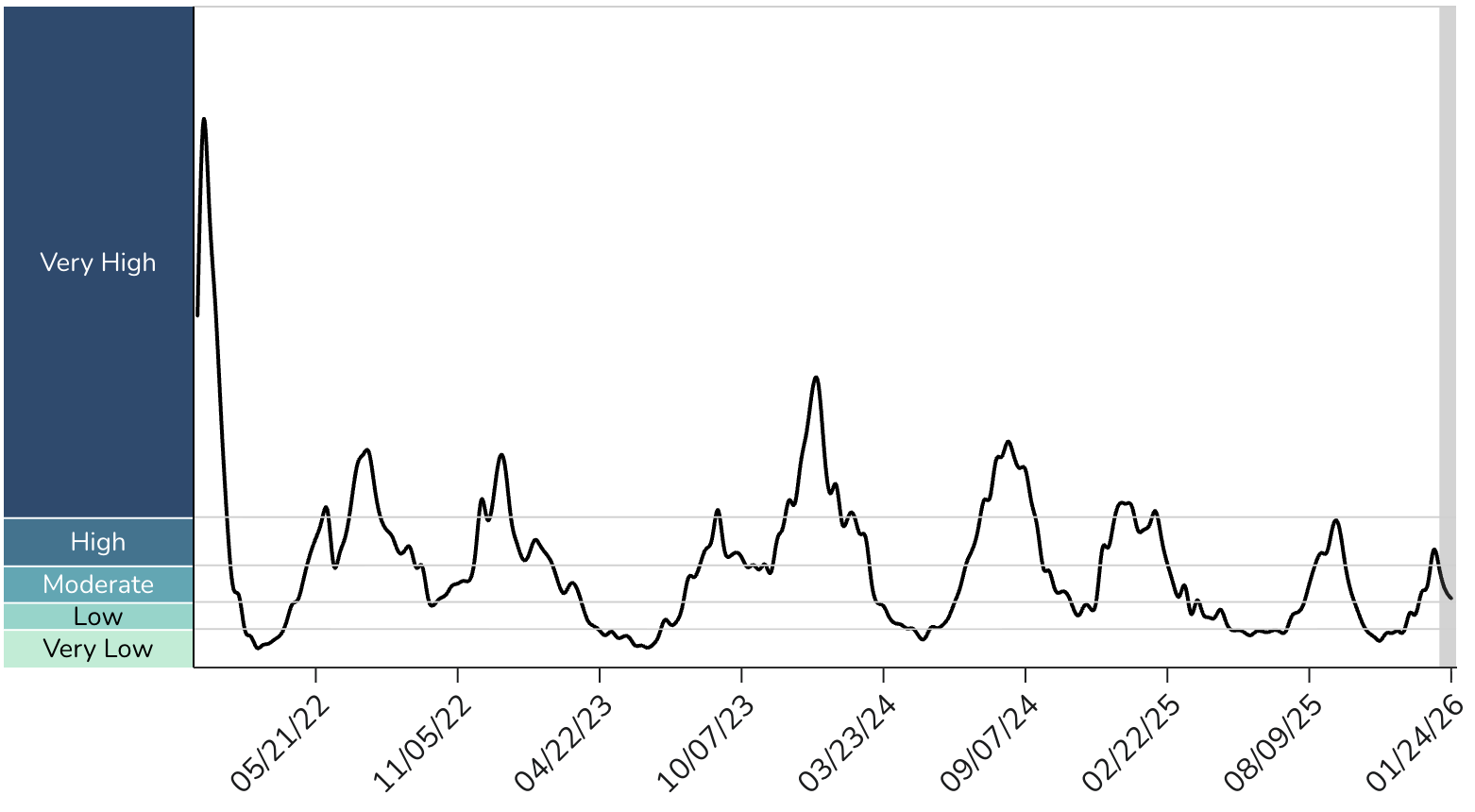
Aggregating across the years and removing the Jan 2022 peak (outlier) yields the following graph:
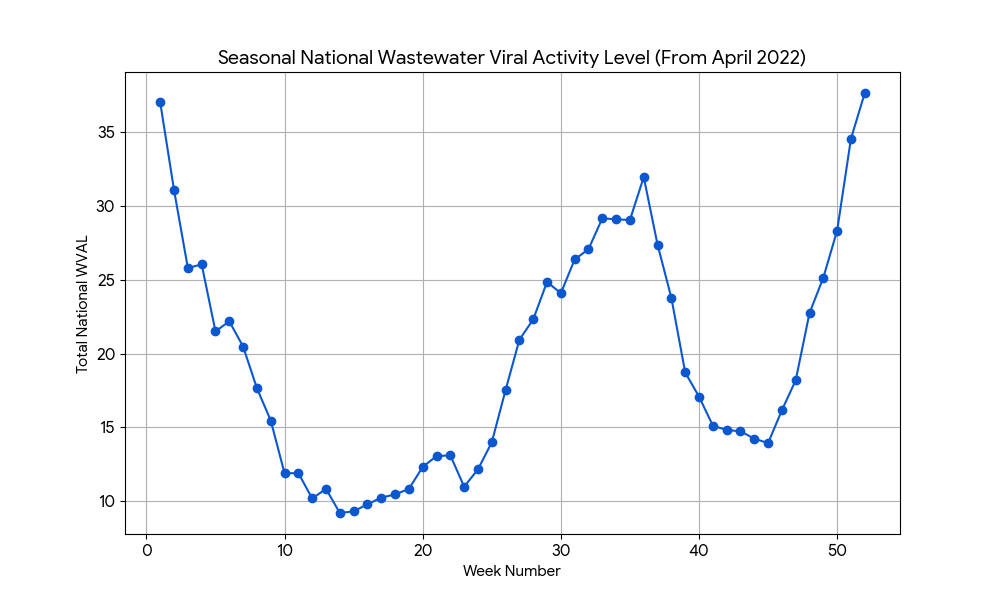
The following two periods have prevalence over 20:
- Nov 25 to Feb 18.
- July 1 to Sept 22.
Therefore, be extra careful during those periods.
How COVID is spread
To contract COVID, one needs to inhale around 100 to 1,000 viral particles. If a contagious person is:
- Physically close to you,
- Coughing or shouting
- Indoors,
- Next to you for a long time,
then there will be more viral particles in the air for you to inhale and potentially get sick.
On the other hand, if a contagious person is:
- Physically distant from you,
- Talking quietly,
- Outdoors,
- Next to you for only a short time,
then there will be fewer viral particles in the air, reducing the risk of infection.
As a heuristic: if you are within 6 feet of a contagious person for more than 15 minutes, infection is likely.
How to avoid getting COVID
Wearing a mask, preferably an N95, is a highly effective way to prevent COVID.
Be more careful during months of high prevalence. Wear a mask in public spaces. If someone is coughing, they are likely contagious with some kind of respiratory disease.
When hanging out with friends without a mask, ask everyone to take a test beforehand.
Consider your network of friends and "friends of friends" (defining a "friend" here as someone you meet in person without a mask). If any one of them has COVID, you are at an increased risk of infection. A good strategy might be to prioritize friends who primarily hang out with you and no one else.
Vaccine
According to this analysis, the effectiveness of the COVID vaccine is as follows:
| Outcome | Protection at 4 weeks | Protection at 20 weeks |
|---|---|---|
| Infection | 45% | 17% |
| Hospitalization or death | 57% | 34% |
Although protection against infection is limited, protection against hospitalization or death is significantly higher.
According to this recent study by Stanford, young men have a 0.01% chance of developing myocarditis from the mRNA vaccine, but a 10x chance (0.1%) from an actual infection. Thus, vaccination right before the next wave might still be worth it. Due to the risk of myocarditis, wait two weeks before resuming heavy exercise and start slowly.
Avoid the flu as well
Even though the long-term consequences of the flu are much less than that of COVID, avoiding the flu is still worthwhile. It's possible to get the flu and COVID at the same time, potentially worsening the symptoms. The flu vaccine is much safer than the COVID vaccine. Serious side effects from the flu vaccine occur in less than 2 per million, and it does not cause myocarditis. According to data from the CDC, the flu is most prevalent from the last week of October to the end March. Thus, get the flu vaccine some time in October.
How to not pass COVID to others
Know whether you are contagious. While contagious, you should self-isolate or wear a mask when meeting others. If you plan to hang out with friends, inform them that you have COVID and cannot attend.
Buy antigen test kits on Amazon. Since tests can yield false negatives, it is advisable to test repeatedly over several days; treat the result as positive if any single test comes back positive. Even if the line is very faint, the result is considered positive. If the test is positive, you are contagious.
Even though symptoms take 3 days to appear, you can be contagious 1 day before symptoms appear. You are usually contagious for 10 days.
How to recover from COVID
Rest as much as possible to reduce the probability of developing Long COVID. Avoid exercise for at least 3 weeks and avoid work until symptoms improve.
The future
Whenever a host is infected, the virus mutates. As long as humans and animals continue to contract the virus, it will keep mutating to evade current immunity. With current knowledge, no cure exists, and no vaccine guarantees complete immunity.
The long-term consequences of COVID will likely manifest as increased rates of heart disease and other chronic illnesses, potentially without people realizing that COVID is the root cause.
Given the history of pandemics, we can anticipate future outbreaks that may kill millions of people and cause trillions of dollars in economic damage.
However, there is hope. World leaders can learn from the COVID pandemic and better prepare for the next one. Technology is rapidly improving and will accelerate even further with the help of AI. For example, AlphaFold has transformed drug discovery, and a universal flu or COVID vaccine could become a reality within the next 5–10 years.
As an AI researcher, I have the potential to create new knowledge that saves lives. The vision of a better future motivates me to work harder and make that future a reality.